

AMSIC- Africa at LINKEDIN
|
Welcome to the African Membrane Society site.The mission of the African Membrane Society (AMSIC) is to train a critical mass of experts in the field of membrane science, filtration and sustainable energy technologies across Africa. AMSIC further encourages the enrollment of students in the STEM disciplines (science, technology, engineering and mathematics). AMSIC seeks to facilitate and ensure access to clean drinking water, clean ambient air quality and improved human health on the African continent and other regions of the world. |
|
||||||||||||||||
AMSIC Newsletter, issue 10 (En) December_2020 - Download PDFNewsletter #10, Editorial Notes, -(English)
Main accomplishments in 2020
| ||||||||||||||||||
| ||||||||||||||||||
AMSIC Newsletter, issue 8, January_2020 - Download PDF (English Only)Bulletin #8,Editorial Notes, -(English)
The prevalence of socio-economic disparity across the globe has reached a level triggering intense debates among key stakeholders from the government and policy-making branches, research and higher education circles, and community advocacy groups. To complicate matters, fixing the uneven distribution of wealth must account for other pressing challenges reflected by weather instabilities and climate change, fast-expanding demographics in some regions, shrinking agricultural landscapes, or weaker ecological systems. For Africa, moving to an era of industrialization offers some attractive opportunities to most effectively support several vital and basic needs from its citizens – i.e. 1.2 billion inhabitants, with 45% of them living in urban centers. With a population expected to double by 2050 and a limited contribution to the global fossil fuel consumption, the continent will have to build its industrial infrastructure by finely balancing two strategies: a) advocating for more relaxed constraints related to CO2 emissions control; b) promoting sustainable innovation and implementing environment-friendly technological solutions. The 3rd African Membrane Society Congress seeks to examine how filtration and energy experts can advance sustainable development agendas benefiting both urban centers and small isolated communities. Specifically, activities subsequently highlighted are the cornerstone of AMSIC strategy to encourage durable changes in synergy with local residents and respectful of the environment.. Air Filtration & Quality: with 92% of the world population living in areas where World Health Organization air quality guidelines are not met, AMSIC intends to prioritize issues of air filtration, air quality in its technical programs and to treat nonwoven/fiber materials sciences as an integral component of the membrane science disciplines. Experts from the nonwoven community will prepare “air tutorials” during AMSIC-3. Other technical contributors will engage in a conference, educate and share data on nonwoven materials utilized for indoor air filtration and ambient air treatment.. Exposition and Technician workshop: there are numerous ways to create conditions favorable to build an industrial infrastructure, which for Africa, will help alleviate vital needs and close socio-economic gaps. Our network seeks to play an active role by supporting a commercial exposition bringing together local and international exhibitors from the filtration and energy industries. Another key project aims to create training certificates for technicians with a strong focus on hands-on competencies. Our goal is to start a couple of multi-national projects in Africa by 2021. AMSIC-3 plans to host a Question/Answer round table session on the final proposal and debate on the next steps.. Abdoulaye Doucouré AMSIC Newsletter, issue 8, January_2020 - Download PDF (English Only
| ||||||||||||||||||
Bulletin #7, Notes éditoriales, -(French)
Avec des universités classées au meilleurs rang à l’échelle Africaine et un grand nombre de centres de recherche et de pôles technologiques, la Tunisie s’affirme comme un pays qui mise sur le développement des compétences, l’encouragement à la valorisation des résultats de la recherche à travers le partenariat entreprise-université et la mise en place de bonnes pratiques de création d’entreprises pour développer une économie moderne et concurrentielle. La Tunisie accueillera le 2ème congrès international Francophone Francophile sur la filtration et les techniques séparatives qui aura lieu du 23 au 25 Septembre 2019 à la ville balnéaire Hammamet. Il succédera au 1er congrès Francofilt qui s’est déroulé durant la période 29-31 Aout 2017 à Bordeaux et qui a connu un franc succès. Ce congrès sera co-organisé par la Faculté des Sciences de Sfax (Université de Sfax (Tunisie), l’Université de Blida (Algérie), l’Université de Bordeaux (France) et l’Institut de la Filtration et des Techniques Séparatives (France). Les techniques séparatives, essentiellement celles se basant sur la technologie membranaire sont en plein développement dans le monde, qu’il d’agisse du domaine de l’environnement, de la santé, de l’eau ou du domaine industriel. Cette année la devise du congrès concernera les aspects spécifiques des techniques séparatives et des procédés membranaires portant sur l’adaptation des progrès techniques aux contraintes locales. Cet événement sera l’occasion de débattre et discuter des questions techniques, scientifiques et socio-économiques de la science et de la technologie des membranes et de découvrir les dernières avancées et les pratiques les plus innovantes en matière de séparation Solide/Fluide et des technologies membranaires. Des échanges entre experts de la recherche et industriels, ingénieurs, exploitants et décideurs sur des thématiques pointues et spécialisées offriront des opportunités de réseautage et de socialisation. Les deux journées de Francofilt 2019, seront consacrées aux interventions techniquesqui combineront des présentations orales, des interventions plénières et keynotes, des table-rondes et des posters scientifiques. Rendez-vous à Francofilt ! Raja Ben Amar Full PDF Download #7
| ||||||||||||||||||
Newsletter #6, Editorial notes, -(English)
Welcome to the African Membrane Society Newsletter!
| ||||||||||||||||||
Newsletter #6, Editorial notes, -(English)
Welcome to the African Membrane Society Newsletter!
Since its inception in 2014, the African Membrane Society has been in the forefront of leadership, advocacy, and education for the development of all facets of membrane technologies and processes in Africa. The members across the continent and around the world are contributing to the advancement of the science and engineering of membranes. They are committed to democratize the science and engineering of membranes in Africa. That’s why our members are always looking for more students to work on this exciting and promising field of broad application potential whether for cleaner water and air production, medical application for blood filtration or else. One of the main objectives of AMSIC is to teach and train a critical mass of students to be scientifically and technologically capable of harnessing the potential of membranes in the sustainable industrial development of Africa. To this end, AMSIC is calling for partnership and collaboration between its members and between its members and external experts in the field of membranes from various horizons (academia, industries, public organizations, etc.) Full PDF Download #6
|
||||||||||||||||||





Edward Nxumalo
|
The 2nd African Membrane Society International Congress (AMSIC-2) will be held in the City of Johannesburg (South Africa) from July 29th to August 1, 2018
The AMSIC-2 will be hosted by the Nanotechnology and Water Sustainability (NanoWS) Research Unit of the University of South Africa (UNISA) The NanoWS Research Unit is situated in the UNISA’s College of Science, Engineering and Technology at the Science Campus in Florida (West of the City of Johannesburg). The NanoWS Research Unit has various focus areas of research under which numerous strategic projects relating to nanotechnology and water research are developed. Research topics that will be addressed during AMSIC-2 include, among others:
➢UF, NF, RO, FO and mixed matrix membranes (fabrication and applications),
➢Fabrication and modification of ceramic, ceramic- polymeric and hollow fibre membranes,
➢Composites, nanocomposites, nanomaterials in filtration,
➢ Membranes coupled with renewable energy sources,
➢ Hybrid membrane filtration systems,
➢ Fibrous media for air and liquid filtration.
This event aims to capture key technological advances in fields heavily dependent on membrane filtration such as Water, Biotechnology and Biomedical sciences, Microelectronics, Chemical Manufacturing, Oil and Gas, and Power Generation.
As for membrane studies devoted to water, we will consider water purification projects, analytical/environmental research, urban water cycle and rural community development as well as bioremediation and analysis. The NanoWS research Unit is therefore well poised to host the AMSIC-2. We look forward to welcoming you to the City of Johannesburg in 2018!
PDF Download #5
Newsletter #4, Editorial notes, #4, Sept 2017
Abdoulaye Doucouré |
 |
Demographic Factors 2015-2017: What associative issues for the coming years?
In December 2017 AMSIC members vote to renew the Board of Directors of the Association (12 posts). Thus, it seemed useful to us to compile some associative demographic data to appreciate the progress made in three years and to clarify the issues that we will face very soon. The first observation is that AMSIC is still present and it is an exchange platform particularly useful for those interested in the emergence of membrane and filtration processes in Africa. The second observation is the effort of the members of the association, which has been supported by other academic and industrial structures whose scientific expertise has been beneficial (The projects have thus benefited from a better technical visibility). The third observation is the growing community of scientists and professionals based in Africa, who joined the association. A trend that we must rejoice.
At the end of 2017, the AMSIC has close to 90 members spread across the continent's five economic centers (Fig. 1). Half of the members reside in West Africa, those living in North Africa and in other regions of the world, each mobilize one-fifth of the membership. The representatives of the other three continental areas make up the tenth of our members, the majority of whom live in South Africa. One of the immediate concerns of the association is to speed up recruitment in Southern Africa and Central Africa; regions in which the presence of AMSIC remains low.
One third of the 54 African countries have at least one member among the members, making a total of 18 nations. Regional sharing, shown in Figure 2, reflects the presence of AMSIC in terms of the number of countries per region. The other regions of the world have 17 members residing in France, the USA, Italy, the Sultanate of Oman and Malaysia. Recall that the associative vision is to form a critical mass of experts specialized in membrane filtration and technologies associated with sustainable energies. Thus, the association will work for a better continental representation of the AMSIC, with a target of 27 to 36 countries by 2023 - that is to say at least one member per country.

Fig. 1: Geographical distribution
More generally, the associative philosophy adopted, encourages any action conducive to the emergence of a scientific, technological and industrial culture capable of responding to the challenges facing the continent during the 21st century - demographic boom, climate change, food priorities and health, energy needs, security challenge, etc ...
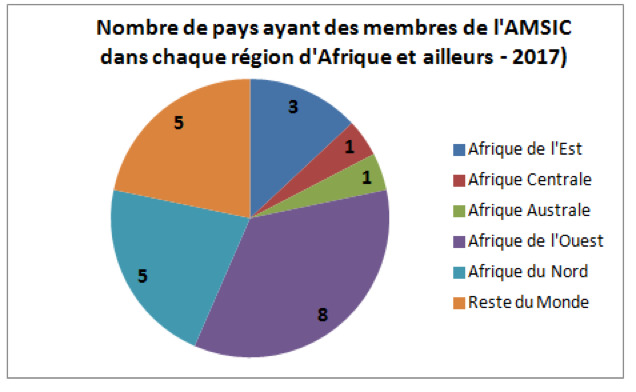
Fig. 2: Number of countries in each region
Internal statistics (Figure 3) show that the male AMSIC population is more than 4 times that of women. This disparity also prevails at the level of the Board of Directors of AMSIC. Although proportionally small, women members play a vital role in capacity building and their contribution has a remarkable influence on the dynamism and scientific reach of the network. However, there is an urgent need to reduce these gender disparities and concrete measures will be proposed just after the election of the new Board of Directors in early 2018.

Fig. 3: Distribution by gender (% men, women)
The comparison of professional and student categories (Figure 4) highlights another imbalance that deserves special attention. Indeed, students and researchers at the beginning of their careers represent only 15% of the associative workforce. However, they actively participate in the international meetings in which AMSIC is involved.

From now on, it is necessary to be even more vigilant to ensure that young researchers and students join the network of associations and get involved in the different committees. Remember that they can register without any fees. As for the professionals of the university world, they are 2.5 times more numerous than the specialists of the industry. AMSIC strives to offer technical platforms (eg scientific meetings) in which academic and industrial players can jointly design research projects that are both innovative and capable of integrating needs motivated by certain societal priorities.

Fig. 5: Projection of population growth
Since 2014, membership has grown from 35 to almost 90 members. This growth is based first of all on the mobilizations made during international meetings. It is by adopting a more aggressive strategy and using the modern tools of information and communication technologies that the associative workforce can possibly double by 2020.
Since 2014, membership has grown from 35 to almost 90 members. This growth is based first of all on the mobilizations made during international meetings. It is by adopting a more aggressive strategy and using the modern tools of information and communication technologies that the associative workforce can possibly double by 2020.
Conclusion
The expansion of the AMSIC network is strategic because it will amplify the opportunities for exchange of experiences and transfer of knowledge to different parts of the continent, and at the same time between Africa and other regions of the world. In order to realize the associative vision that aims to form a critical mass of experts across ALL of Africa, it is imperative to speed up recruitment at the level of states that have no presence in our network. Thus in five years two thirds of African countries could participate in AMSIC.
In addition, we are aware of the challenges posed by the low representativeness of young researchers, student layers and also women within our association. The new Board of Directors will be asked to propose strategies capable of stimulating sustainable representative transformations from 2018.
PDF Download, #4
Newsletter #3, Editorial notes, February 2017
| Edward Nxumalo Associate Professor University of South Africa |
The 2nd African Membrane Society International Congress (AMSIC-2) will be held in the City of Johannesburg (South Africa) from the 29th of July to the 1st of August 2018. The AMSIC-2 will be hosted by the Nanotechnology and Water Sustainability (NanoWS) Research Unit of the University of South Africa (UNISA) The NanoWS Research Unit is situated in the UNISA’s College of Science, Engineering and Technology at the Science Campus in Florida (West of the City of Johannesburg). The NanoWS Research Unit has various focus areas of research under which numerous strategic projects relating to nanotechnology and water research are developed. Research topics that will be addressed during AMSIC-2 include, among others:
UF, NF, RO, FO and mixed matrix membranes (fabrication and applications),
Fabrication and modification of ceramic, ceramic-polymeric and hollow fibre membranes,
Composites, nanocomposites, nanomaterials in filtration,
Membranes coupled with renewable energy sources,
Hybrid membrane filtration systems.
This event aims to capture key technological advances in fields heavily dependent on membrane filtration such as Water, Biotechnology and Biomedical sciences, Microelectronics, Chemical Manufacturing, Oil and Gas, and Power Generation.
As for membrane studies devoted to water, we will consider water purification projects, analytical/environmental research, urban water cycle and rural community development as well as bioremediation and analysis. The NanoWS research Unit is therefore well poised to host the AMSIC-2. We look forward to welcoming you to the City of Johannesburg in 2018!
PDF Download, #3
AMSIC Newsletter, issue 2, September 30, 2016 - Download PDF (French Only)
Newsletter #2, Editorial notes,
AMSIC Newsletter #2, September 30, 2016
|
||
| ||
|
AMSIC Newsletter, issue 1, 2015 - Download PDF
|
||
The African Membrane Society is the result of discussions initiated in August 2010 in Bamako at a workshop of the Mali Symposium on Applied Sciences. Experts on water and membrane technologies present at the meeting had then expressed the wish to create a continental structure able to meet the following expectations:
AMSIC virtual network was created in 2011 which comprised about thirty members from West Africa, North Africa and some members in North America. After the launching of a virtual platform, this group has appointed an interim executive body that continued to operate between 2012 and 2014.
This newsletter aims to providing greater visibility to AMS activities (members, resources, projects, etc.), to present current projects on the promotion of filtration processes in Africa, and to integrate contributions of our esteemed partners. Abdoulaye DOUCOURE
|